Monday, June 2, 2014

A long walk + Paris part 5

After our chocolate binge last night, I decided to walk the loop all the way around Alster Lake today.  I've never done the whole thing before.  It was a nice day and a nice walk.  I saw some swans in their nest at the lakeside with their babies, and when a dog came near they spread their wings and hissed!  They look freakishly serpent-like when they do that.  Even the dog knew to stay far away!

I was almost done with the loop when I spotted a leather satchel under a tree by the water.  No phone or wallet, but a lot of other stuff in it, and some mail with an address.  So I figured I'd better turn it in to the police.  Only I couldn't remember where the nearest station was, so I trudged a LONG way before I got to the one by Georgi-Haus.  Good grief, that bag was heavy!  I was so relieved to finally give it to the police so I didn't have to carry it anymore.  Maybe the lady dumped it on purpose because she was so tired of lugging it around .  . .

Also, Indra's birthday present to me finally came in the mail today!  She was so excited for me to open it.  It is SO CUTE!  It's a personalized green ceramic bowl with Olaf from Frozen on it, and he has a little speech bubble coming out of his mouth where he is saying "Sommer!" (Not a misspelling, it's the German word.)  I love it because the green and the German remind me of Indra, and because I can use it to eat cereal out of, and of course because it has Olaf on it!!!

Anyway, I am officially finishing this Paris saga today!  I have to, or I'll never get around to doing any homework before I leave for London!

Sorry this post is so long . . .  Photos at bottom, as usual.

Day 6: May 27, 2014

I hadn't been to the Père-Lachaise cemetery yet, so I decided to make that my first activity of the day.  After breakfast and a baguette purchase, I walked there--it wasn't very far--and spent the next few hours tripping around exploring the cemetery.

This place is pretty crazy!  It's about two centuries old, and over 70,000 people are buried there.   Especially in the center and the southwestern corner (which I think are some of the oldest parts), it feels like a maze.  Even with a map, it's really hard to find your way.  I didn't know where the main entrance was, so I actually ended up going in the back way and didn't get a map.  I took a photo of the map on the board at that entrance and kept having to look at the picture on my camera to navigate, which made it a bit more tricky.  Probably that was dumb of me--once I figured out that real maps were available, I should have gone to the main entrance and gotten one.  In some spots, though, even the people I saw with maps seemed confused, simply because there are so many little streets and pathways and SO many graves of all sizes.  The navigation wasn't really a problem except for when I had a desperate need for the bathroom and couldn't find it!  I was literally about to explode when I finally came around the other side of one of the buildings near the main entrance and saw the "WC" sign.  Phew!

There are a lot of famous people buried at Père-Lachaise.  In The Count of Monte Cristo, it is also the place where the Villefort family has their burial vault.  Because of the maze-y quality of the place, it can be a real challenge to find the graves, even though they are marked on the map.  The plots aren't labeled with numbers, and you don't know what sort of a tomb the famous person is buried in until you find it.  In a way, it's kind of fun, like a scavenger hunt.  Though I think it would take all day, at least, to find every famous grave listed on the map!  There were a lot of people at the graves of the musicians and writers: Fréderic Chopin, Edith Piaf, and Oscar Wilde (the last of whose grave was extremely ugly, with some kind of a weird winged Art Deco-ancient Aztec-ancient Egypt-combo figure).  Jim Morrison was buried there, but I didn't ever listen to the Doors and I knew five dozen people would be probably thronging his grave, so I didn't even bother to look for it.

I found the tombs of all these people:
  • Gioacchino Rossini (composer of the "William Tell Overture")
  • Baron Haussmann (in charge of the remodel of Paris under Napoleon III)
  • Théodore Géricault (painter of The Raft of the Medusa, which is in the Louvre)
  • Honoré Daumier (political activist and artist who advocated the French Republic during the turbulent times of the early 1800s)
  • Jean-Auguste-Dominique Ingres (Romantic painter of the mid-1800s, known for depicting exotic Turkish scenes; his work is in the Louvre)
  • Jacques Louis David (did all the most famous paintings of Napoleon, such as Coronation of Napoleon and Napoleon Crossing the Alps; he was AMAZING and most of his works are in the Louvre)
  • Georges Seurat (Impressionist/Post-Impressionist painter, most famous for the pointillist "tiny dot" painting Sunday on La Grande Jatte)
  • Georges Bizet (composer, best known for the opera Carmen)
  • Gustave Caillebotte (painter from the mid-1800s; a few of his pieces are in the Musée d' Orsay)
  • Georges Méliès! (pioneer of early filmmaking, whose life is the central focus of the Hugo movie)
There were other people there too of course--scientists, writers, and others whom I had heard of, but I didn't have even close to enough time to look for them all.  I ate my lunch on a bench near the chapel in the middle and admired the view of the city (it's on a hill which looks west towards the Eiffel Tower), then set off to walk back to Victor Hugo's house.  This time it was only about 2 o' clock and I was able to go in and see the apartment he had once rented at the Place des Vosges.  It wasn't the most exciting tour in the world, but the apartment was very nice and spacious, with some beautiful furnishings.  (Hugo was obviously pretty well off; I think he came from a fairly prestigious family.)  I learned that his beloved oldest daughter Léopoldine died early, at age 19; that his wife Adèle was excellent at portraiture and that Hugo himself also drew as a hobby; that his son François-Victor also became a successful writer whose crowning achievement was a translation of Shakespeare's complete works; and that despite a lifelong marriage and four children, Hugo had a long-term affair with a woman named Juliette Drouet (shame on him!).  My favorite thing on display was a medieval-style multi-panel painting illustrating scenes from The Hunchback of Notre Dame.

After that I zoomed to Sainte-Chapelle, which is on the Île de la Cité west of Notre Dame.  I wanted to visit it before it closed at 6.  (On the way I peeked inside another church, Eglise St-Gervais, but it wasn't terribly spectacular.)  Sainte-Chapelle is actually inside the courtyard of the Palais de Justice (Palace of Justice), and you have to go through a security checkpoint to enter.  I got free entry (I love you, student ID card!).  And thankfully, I squeaked in just a couple minutes before they closed the admission for the day.

The chapel is absolutely AMAZING!  A fair amount of tourists go here, but you can definitely see why.  The building itself is tall, but doesn't have a lot of square footage.  What makes it so impressive is its two stories and its stained glass.  There is a small downstairs chapel on the first level with a low vaulted ceiling and a statue of St. Louis (medieval king who was the original benefactor of the church). The walls, columns, and ceiling are beautifully painted in red, blue, and gold with star, castle, and fleur-de-lys motifs.  There are also some very nice stained glass windows.  This first level is enough of a wow factor, but when you go up the little spiral staircase to the second story, your jaw really drops.  The chapel is basically a minimal stone frame with such large and tall windows that it looks more like it is has stained glass walls.  All the colors . . . it's like looking at a million jewels.  Thousands of little pictures in the windows illustrate most of the Old Testament books, the life of Christ, the Last Judgment, and the historical events surrounding the creation of the chapel.  The rear windows and some of the side windows were covered up because they're finishing a six-year restoration project on the stained glass, but that didn't detract from the spectacularity of what you could see.  Even the floor had fancy patterns on it.  I felt like I could stay and look at it for hours if it hadn't been closing time.  I only was there for about ten minutes before they kicked everyone out, but I didn't mind.  At least I had gotten to see it.  Highly recommended to anyone who is planning a Paris trip!

After that I walked over to the Latin quarter near St. Michel, where the Sorbonne, Panthéon, and all the Universities of Paris are.  I figured I should at least have a quick peek at them.  The Panthéon's dome is currently being renovated.  It is open during renovation, but I got there too late to go in.  I checked out the outside though, and also peeked into one other church just behind it, St. Étienne-du-Mont.  This district rather obviously has the full-on student vibe.  It was 6:30 by then, but there were still some young people getting on and off the bus, walking back and forth with backpacks and school bags, or sitting on the ground leaning against a wall with a snack, iPod, and textbook open on the lap.  College life is the same everywhere!

Then I went back down into St. Michel to make one final attempt at finding Le Procope.  It was my last night in Paris, and by hook or by crook I was going to eat at a nice restaurant in honor of my birthday!  I decided to try going a different way, down the one part of the Boulevard St-Germain that I hadn't walked before, and--lo and behold--there was a little narrow street off to the right that looked really old.  I wandered down it a little bit.  On the left side of the street was an old-looking building, like early 1800s style, and a sign: Le Procope.

Yessss!

I had a peek at the menu.  They had an offer for a two-course meal for 20 euros, like Cindy had told me about.  So I went in.  It was definitely fancy: white tablecloths and multi-glass, multi-utensil table settings.

It turned out I went in the back way.  (That was the theme for the day, apparently.)  I was promptly seated at a table for two in a room where several other parties were already seated.  I think at that point we were the only occupied room in the place.  At another table for two immediately next to me (the tables were pretty tight) was an elderly man in a suit, around 75 years old.

Unbeknownst to me, my Paris restaurant experience was about to take on the quality of a scene from a novel or a film.

I got my menu and started perusing it, and didn't pay much attention to the old man until he nudged me and asked, "What will you have?"  I told him I had to decide, and I wasn't sure yet.  He said, "The oysters are very good."  I told him that I didn't think I wanted something as fancy or expensive as oysters, and that I liked fish and chicken best.  He told me, "I recommend the coq au vin.  Chicken in wine, very good."

"Okay, thank you," I said politely, and went on looking at the 20-euro menu (which did not include coq au vin, unfortunately).

"And what will you have to drink?" he asked me.  I told him, "Oh, just water."  He looked at me.  "That won't do at all," he said.  "You must have some sort of wine!"  I started to say I wasn't going to get wine because I don't have a taste for it (anyone who knows me knows I don't drink at all), but he said, "Here. You must try mine."  He picked up the little carafe on his table and poured me a glass.

"Um, thank you," I said, and tasted it.  Bitter, of course, at least to someone who really does have no taste for anything alcoholic, but I could tell it was a pretty nice wine, so I periodically sipped it to be polite.  It was red, but actually chilled, and a bit thinner than most red wines I've seen, so that made it a little less potent.

When the waiter came (at the request of the old man, who informed him, "Mademoiselle is ready to order now"), I ordered from the 20-euro menu, which only had a couple of choices.  Terrine (which is a kind of pâté) with a miniature salad for the first course, and some kind of white fish garnished with bell peppers, spices, and butter and served with potatoes for the second course.  It was rich (especially the terrine) and super delicious.  The old man had jumbo shrimp with butter for his first course, veal kidney in a dark sauce with spicy mustard for his main course, and vanilla ice cream with strawberries and crème Chantilly for his dessert.  All the while, he asked me questions about myself, where I was from, and what places in Paris I had visited.  He was obviously a regular, because all the servers seemed to know him.  They smiled and obliged him, even when he was putting in requests for me--"Please bring a dessert menu for mademoiselle"--and they chatted with him when he asked them about their countries of origin. (It was actually quite an international place.  Most of the diners were tourists, one waiter was Italian, and one of the waitresses was from Russia.  I think the old man was the only French patron in the room.)

There was an Australian couple from Melbourne sitting on the other side of him.  He started chatting with them too, and pretty soon we had a three-table conversation going (with occasional input to and from other tables).  The old man did tell us some things about himself too--he was a lawyer, his sons had studied in New York, he himself had traveled quite a bit.  He said he was in Las Vegas last year, and he asked me if I had ever been there.

For dessert I had the handmade fruit sorbet.  I wanted tiramisu, but after the terrine and fish I was too full for that.  The old man kept telling me I should get the strawberries and ice cream, but I told him it would be too much. (It was funny--the one time the waiter wouldn't put up with him was when they brought his dessert.  They set down the ice cream and strawberries in front of him, and the dish of whipped crème Chantilly next to it.  He picked the cream up and set it on my table.  "Mademoiselle may have the cream," he said.  The waiter said firmly, "Non," and put it back on the old man's table.  I think they were a bit irritated that he was discouraging me from paying for my own food!)

At some point the Australian guy said, "Oh, by the way, my name is Bob and this is my wife Sally." (I don't remember what the names actually were.)  He asked me what my name was, I told them, and then he turned to the old man. "And you are . . . ?"

The old Frenchman waved his hand.  "Bah.  Does not matter.  It is not important."

At that moment, I decided he was the most endearing old man ever.

Before he left, he told me and the Australians that we had to see the upstairs rooms.  "This is an old restaurant, very historic."  He told the Italian waiter, "Be sure you give them a tour of the upstairs.  They must see it."

"Of course, Monsieur," the waiter agreed with a smile.

The old man finished his coffee, paid his bill, set his napkin down, and said, "I will leave now.  Au revoir, mademoiselle, I wish you all the best in Paris."  And he kissed me on each cheek--the Parisian way--then got up from his table, shook hands warmly with Bob and Sally, and left the restaurant.

I still have no idea who he was, and (like Ineke) I took no pictures of him.  It was honestly like he stepped right off the pages of a book.  And somehow the fact that he wouldn't tell anyone his name added to his overall charm.  It was almost better not to know who he was.

These kinds of experiences generally seem to be nonexistent in California.

Anyway, the waiter showed us the upstairs as promised, and it was very cool.  The restaurant wasn't at all busy that night, but it is actually quite large, and it has been open since the 1600s.  Many famous political figures and writers frequented it in the Revolution days.  The wallpaper says "Liberté, Egalité, Fraternité" on it, with the axe and rosette of the French Revolution era, and upstairs they have the table where Voltaire used to sit and drink cup after cup of coffee every time he came in.  They also have, framed on the wall, the original of the last note Marie Antoinette wrote from prison before she went to the guillotine!

The staff was very nice and let me stay as long as I wanted while I did some drawing.  I finished my sorbet and slowly managed to sip my way through about three-quarters of the wine glass.  In tiny occasional amounts, it was definitely a nice compliment to the rich dinner.

I didn't leave the restaurant until after 10.  I didn't want to go . . . it had been awesome.  30 euros for a three-course meal, and some very interesting people.  I think I had the Paris restaurant experience, even if the restaurant had more of a tourist clientele than a local clientele.  That one old Frenchman gave the place some serious vitality and atmosphere!

I did one final night walk along the Seine and past Notre Dame, and then sat and savored my spice-bread caramel on the Pont Notre-Dame, listening to a street musician play his saxophone on the other side of the bridge.

It was an amazing night.

Day 7: May 28, 2014 

My last day!  I was sad to have to leave, but my flight was in the evening so at least I had most of the day.

I had one last light breakfast in the hostel, but this time I had only one roll instead of two because I wanted to get one special pastry or baked goodie from a boulangerie before I left Paris.

First I got Marni a French chocolate bar at the market, and then went across the street to McDonald's.  I hated having to go into a McDonald's in Paris, but they had free wi-fi and I needed to download my boarding pass.  So I went in just long enough to get the mobile pass on my iPod, and then bailed out.  So weird . . . they look the same even in France, only they offer French things like macarons and croissants in addition to the regular menu.  (Can you imagine a McDonald's macaron???  UGH.  Who in their right mind would ever eat that?!?)

Rather obviously, I went to a place that sold REAL French bakery food to get my special treat.  It literally took me 20 minutes to decide.  They had so much good stuff!  Tiramisu, fruit and chocolate tartelettes, gâteaux, millefeuilles, opéras . . . I was at a loss.  At long last I chose a nice large slice of chocolate torte.  I walked down the street to Place de la République and ate it, very slowly, sitting on the fountain in the place.  And WOW.  It was like a chocolate overdose, but SO GOOD.  White crust that was like a pie crust, with a bitter ganache filling and a super-sweet chocolate glaze over top.  I didn't regret my choice at all.  Spent about 20 minutes eating it, to be sure I got the maximum enjoyment out of it.

After that I took the Metro to the Bibliothèque Nationale de France (National French Library) south of the Gare d'Austerlitz.  I thought it was the famous library with the Industrial Revolution style ceiling and the arched windows.  Come to find out, it was the modern library, which was not at all exciting to look at and which required a pass or an admission fee to enter the collections.  (Later when I got home, I looked up the library I had wanted to visit and had a moment of extreme annoyance.  The one I had been thinking of was the Biblithèque Sainte-Geneviève, which is at the University of Paris just next to the Panthéon.  I had been right there, standing just outside it, right next to its wall, and I hadn't known it!  Argh!  I was like, "Really?  REALLY??  Seriously?"  So annoying!)

Anyway, that felt like a waste of time, which was a bummer.  I took the Metro back to the Île de la Cité to see if I could do the Notre Dame tour before I had to go back to the hostel and get my bag to leave for the airport.

It turned out that the free guided tour is separate from the tour up into the bell towers, which you have to pay for.  But it was a God moment--I ended up at Notre Dame right at 2 o' clock, when the daily guided tour in English was starting!  So I zoomed inside.  At first all I saw was the French-speaking tour sign, and then the lady appeared with the English sign.  Immediately thirty or so people around me were like, "ENGLISH!' and all swarmed around the tour guide.  I didn't want to be stuck in a huge tour group.  If only I could be in a little group, like the French one with only four people, I thought.  I looked at the English tour, then at the French tour, then back at the English tour . . .

And walked over to the group under the "Visite française" sign.

The tour guide asked me, in French, if I was French-speaking.  I told her, very sloppily, that I didn't know much but that the English tour was too big.  She seemed a little concerned for me, but I told her it would be fine, I could understand enough.

The tour was pretty long--like two hours--and it was definitely a challenge.  My brain hurt!  And I don't think I got nearly as much information out of it as I would have in the English tour.  But it was a good experience, I think, and it was definitely nice to be in a smaller group.  And I got to spend more time inside Notre Dame, which was of course awesome.

After the tour was done, I talked to the tour guide a little bit, as best I could, and thanked her.  Then I sat in the church for a little bit longer.  There was a young couple by me that was praying and crying, and I asked if they needed me to pray with them, but they said they were okay.

It was actually amazing--while I was sitting there and drawing, I started thinking how incredible it is that we can talk to God, no matter where we are or what we're doing, and He hears us and will answer. We are worth nothing, but He hears us and cares about everything we have to say.  I had kind of a sudden emotional moment, because I just was suddenly struck by the weight of that thought.  God hears me.  And He hears any of His children who call on Him.  That is amazing.

I had to leave then, because it was 5 o' clock.  I collected myself, put away my sketchbook, had one last look at the beautiful arches and stained glass, and left the church.  It was raining outside, like even the weather was sad I was leaving.  I put up my umbrella, zoomed to the caramel and macaron shop in St. Michel and bought some caramels for Indra and Petra, and then took the Metro back to my hostel to get my other backpack.  From the hostel I took the Metro to the Gare du Nord.  Aaaarrrrghh!  It was so frustrating to be leaving at that time!  It was rush hour and there were a zillion people cramming every train, every stairway, and every passageway.  At the Gare du Nord I went out the front of the station and bought a crêpe with butter to go, then went back inside and, after much frustration and annoyance, succeeded in buying my ticket to the airport and finding the train line I needed.  Only when I finally got onto the train to the airport was I able to calm down.  I don't know why, but I just got incredibly irritated and angry while I was trying to figure out the ticket thing.  All the ticket machine lines had been long, I couldn't find the correct train because there were so many stairways and signs and people milling around everywhere . . . but I had left my hostel with plenty of time to get to the airport, and I wasn't late or anything.  So I don't know why I got so annoyed--lack of sleep, maybe.

Anyhow, I ate my crêpe on the train, found my terminal without trouble, and was at the gate with 20 minutes to spare.  It was a nice and mellow flight back, and I was in Hamburg by 10 pm.

So there you have it.  Paris.  Cross that off my bucket list!  I hope I can go back someday.  It is a beautiful city, and I had such a good time there.  The best birthday week I could have asked for!

Bam. DONE.

Here are more photos from Days 6 and 7!

Some of the vaults were really old and a lot of them had been vandalized or had
trash thrown in them, which I thought was sad.


One of the streets in the cemetery was named Rachel . . .

and it also had a crypt with my name on it.  Creepy!

Lots of green!

Thank you, Mr. Rossini, for the William Tell Overture!!!

Géricault's grave--notice the plaque depicting the Raft of the Medusa on the front of it.

Chopin's grave

Georges Méliès's grave!  There were rolled-up notes in the
scrolly things on the posts at the sides of the gravestone.

The view of the Place des Vosges out Victor Hugo's apartment window


The Pont Notre-Dame, which in Les Misérables is the bridge where Inspector Javert commits suicide.  The prefecture of police is still located next to this bridge, in the big white building on the left side of the picture.
Lower chapel of Sainte-Chapelle

Ceiling of the lower chapel . . . so neat!

The upper chapel!  WOW!

So many colors!  Imagine being the one who made this . . .


Place du Panthéon, in the student district

The Panthéon (dome is currently under renovation)

Fancy!

Drawing at Le Procope

Le Procope, later in the evening.  (The old Frenchman and the Aussies had left by this point.)


Upstairs room at Le Procope.  It was unoccupied that night.

The "Voltaire table"

Marie Antoinette's last note before meeting Madame La Guillotine

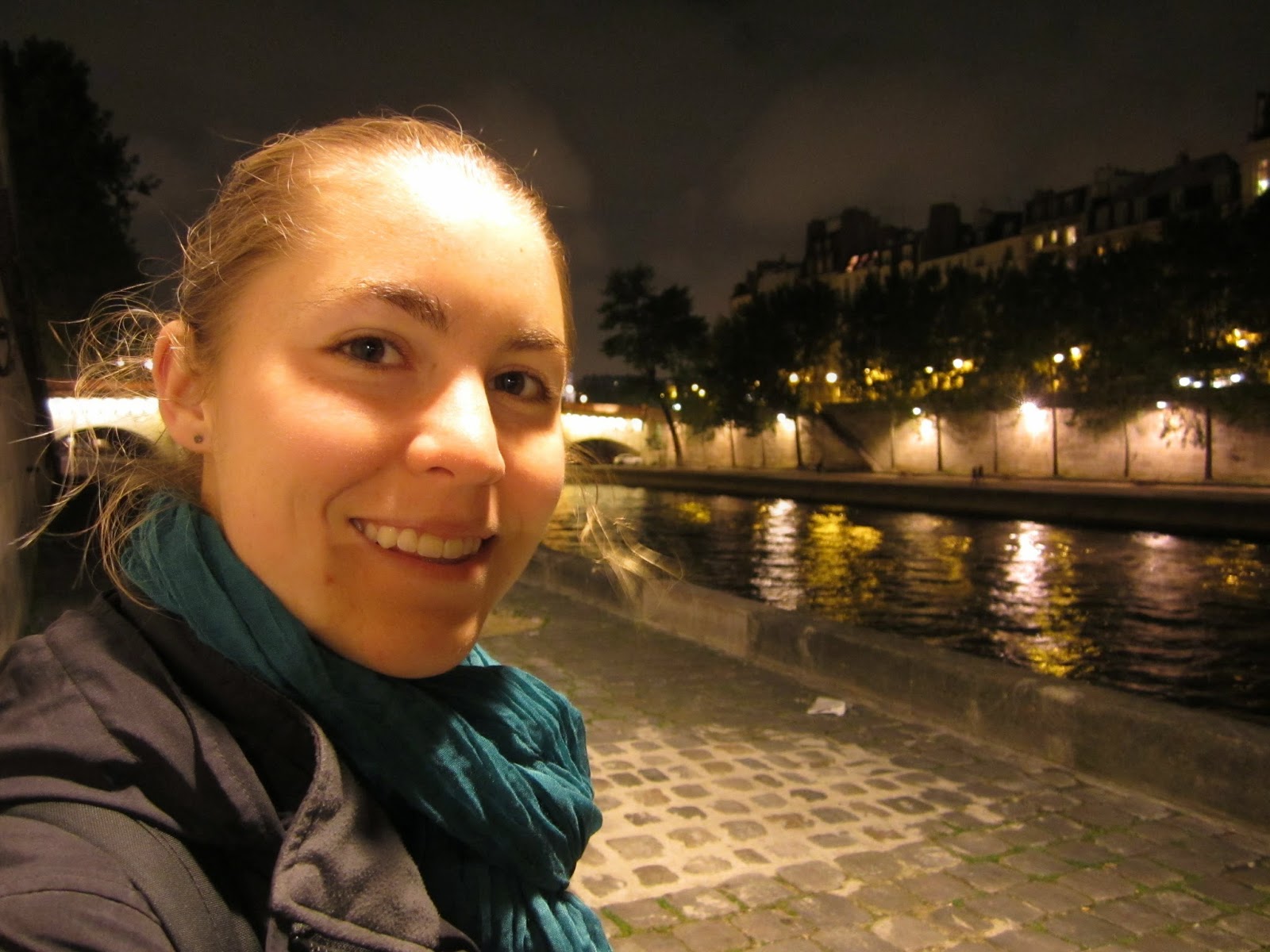
Walking on the Seine quay after dinner


Night views of Notre Dame


Shadows on the opposite quay

And the next day . . . CHOCOLATE BOMB!!!!!

My final visit to Notre Dame
One bummer about traveling alone is that unless you want to keep grabbing random strangers to take pictures of you, your only way of producing photo evidence that you were actually there is reduced to (sigh) the selfie.  Here are a couple more photos that actually have me in them (most of them are silly, but I figured I'd better do at least a few for family purposes).
Fun with a baguette
nom nom nom 

Waiting out a downpour under a tree at the Jardin du Luxembourg

My only Eiffel Tower pics are the far-away ones.

"Favorite landmark in Paris?  Hmmm . . . not sure about that . . ."

Sunday, June 1, 2014

Paris part 4

Just realized that all this time I've had my blog text in a sans-serif font, which is extremely hard on the eyes.  I changed it to a serif font--hopefully that will make things easier for you all to read!  Anyone in favor of a white background instead of black, please let me know.

Petra and Marni came to City Light with me this morning!  It was cool.  We brought a lentil salad to share, because this week the Ropers were busy moving into their new house and Janos & Anja were out of town at the Calvary Chapel missions conference, and they needed help with the lunch for after the service.

Exciting news!  Joey and Janos finally found a building to meet at!  Ironically, it is actually just a few buildings down from Martin & Ivanna's house where the church has been meeting, at the youth center.  Starting next week the church service will be there.  So this was our last week at Martin & Ivanna's.  We all signed a card to thank them for their hospitality in opening their house.  We also had a big food party afterwards.  The service was good too--we had a guest teacher today, Pastor Edmund from CC Dusseldorf, and he taught out of Genesis 26 about trusting and obeying God during the tests of life.

Indra came home this afternoon from visiting her paternal grandma (who lives near Köln).  She, Marni, and I decided to have our previously scheduled chocolate night.  Petra is going to Morocco tomorrow, so she wasn't able to participate, but it was still fun.  We watched the Chocolat movie and ate the assorted chocolates her maternal grandparents had sent her.  There were probably around 40 chocolates and WE ATE ALL OF THEM.  I think I had maybe around ten or twelve, though I wasn't counting.  Marni and Indra definitely ate more of them than I did.  (Like I've said before, Marni's chocolate tolerance is incredibly high.)  They were really good chocolates too.  The pralines were absolutely amazing, though actually I think my other favorites were the white chocolate ones with lemon cream and sour-cherry-cream fillings.  Definitely enhanced the movie experience.

Good grief, I've got to finish writing about Paris.  London is coming up on Thursday!  (What on earth was I thinking, scheduling two weeklong trips back-to-back like that?!?)  I sincerely hope I will get a chance to blog in London, so I don't get so behind.  Though I'll confess it was nice while I was in Paris to have a break from it for a week . . .

Anyway, on with the contes du voyage (travel tales).  Writing about this trip is great in a way, because I feel like it's letting me relive it a second time.  :)

Note: Photos are at the bottom.

Day 5: May 26, 2014

The rain was back that morning.  I made sure to be on time for breakfast--I had almost been denied access to the food the day before because I had come in right at 9:30, just as breakfast time was ending.  The kitchen lady had tried to tell me it was too late and that I couldn't eat, but after I gave her an "oh, s'il vous plaît?" with puppy-dog eyes, to my relief, she agreed to let me get food as long as I was quick. But every day after that, I made sure to be down there by 9:15.  I didn't want to miss out on that bread with jam and butter!

Anyway, after breakfast I got on the Metro and took it to the Pont de l'Alma, one of the bridges near the Eiffel Tower.  (The bridge, I later learned, is named in commemoration of the Battle of Alma, which was the first French & English victory over Russia in the Crimean War in 1854.)  On the south side of this bridge is the entrance for the tour of the Égouts de Paris (Paris sewers).  Being a Victor Hugo geek, I couldn't really go to Paris and not see the sewers--after all, they were only the setting for the most famous scene in Les Misérables.  Plus, I had been slightly underimpressed with the catacombs (though they were cool, I think the tourist hype made them out to be more exciting than they actually were) and I wanted to see an underground view of Paris that was a little more under the radar.

The sewer tour did not disappoint.  It actually turned out to be one of the most interesting things I did while I was in Paris.  And it was also very uncrowded--I got there about ten minutes before it opened for the day, and the only people in line were me, maybe ten others, and two big elementary school groups.  The school kids had a tour guide, but if you are an individual visitor you just follow the signs and the little pamphlet and do a self-guided tour.  Basically it takes you through one little section of the sewer system along the Seine and tells you about the history of the sewers, the modern sewer system, the type of equipment that is used to clean the sewers, and the environmental and engineering aspects of sewer management.  It sounds boring, but it actually wasn't at all.  The displays were really simple, multi-lingual, and informative, and they even had some interactive ones geared toward kids that explained the basics of how the system works and answered the "where does the water go once I flush the toilet?" or "where does the storm drain water go when it rains?" questions.  They had one little section of tunnel that showed what the old sewer tunnels looked like before the remodel in the mid-1800s, and there were all the different sewer-cleaning machines on display as well as dummies modeling the protective gear worn by égoutiers (sewer workers).  My favorite part was the section that explained the development of the city from Roman times to the modern day and the ways the sewer development was tied in with it.  Of course, there was also a mention of the famous sewer-escape scene from Les Mis.

I actually learned a lot about both the Paris sewer system and the urban development of Paris, and just about sewer work in general.  The most fun and interesting things I found out were:

  • On one of the support pillars of the Pont de l'Alma outside the sewer, there is a statue of a soldier.  When the Seine floods, the citizens use the statue to measure the height of the water.  During the big flood of 1910, the water came up to the statue's neck!
  • Around Paris, there are green-painted drinking fountains with Classical-style figures holding up a fancy roof-looking thing.  The water pours down in the middle, and you can fill your water bottle.  These fountains were designed by Sir Richard Wallace and first instituted in the 1870s.  Today there are 113 of them.  Originally, citizens drank from a cup that was attached to the fountain by a chain, but they got rid of this at some point because they realized it wasn't hygienic!
  • The sewer worker's getup includes boots, gloves, a hard hat and head lamp, a safety harness, and an emergency breathing mask.  This equipment is essential for protection in the dark, wet, and unsanitary conditions of the sewer.  
  • The new design for the sewer passages during the remodel under Napoleon III put one pipe along each side of the tunnel: one carrying clean water, and the other carrying used or dirty water.
  • In the early 1600s, King Henri IV commissioned a hydraulic pump to be built at the Pont Neuf to draw drinking water out of the Seine.  The pump was nicknamed "La Samaritaine." Though it's long gone now, there is still a building called La Samaritaine at the Pont Neuf, in the approximate location of the original pump.
  • When Victor Hugo was writing Les Misérables, he got the head sewer inspector (who was a friend of his) to make him a map of the sewer network, so that the famous scene with Jean Valjean's escape from the barricade would be based on real information!
  • Plenty of personal items have been found in the sewer over the years, including two very nice swords still in their sheaths.  Imagine being a stylish young cavalier and losing your sword down the sewer . . . bummer!
  • One of the coolest things they use to clean the sand and silt out of the sewer passages is a floating ball (made of either iron or wood, depending on size) that is just slightly smaller than the tunnel.  They use a heavy flow of water to flush the ball through the passage, and as it spins along, it pushes the sand in front of it.
  • Over time, various methods have been used to spread out the sewer water so it won't pollute the Seine downstream.  The open fields where the water was diverted during the early 20th century were so well fertilized that they grew freakishly large vegetables!
  • Today, Paris has the only sewer system of its kind in the world.  It is a spectacular feat of engineering and planning which was developed out of the necessity of sustaining clean water for a huge population.  All 2100 km of the sewer passages are accessible for inspection by workers.
  • The sewer workforce is made up of several hundred individuals (mostly men, not sure if there are any women) who maintain the passages.  It is a job that the workers take great pride in, and very often the tradition of sewer work is passed on from father to son.

I have to say, I came out of the tour with a much deeper appreciation and gratitude for all those sewer workers in Paris, Hamburg, and back home in California who put in so much effort so we can have flushing toilets, running water, and clean streets.  Their job isn't an easy, safe, or glamorous one, but it's got to be one of the most important in an entire city.  So here's to all the unsung heroes of urban life: the sewer workers.  And kudos to you, "Daddy Craig" Donals, for devoting your entire life to sewer work!  I have a new admiration for you!

After I emerged from the tour (with a bit of a stink in my clothes, I'll admit--that sewer water flowing under the metal grills below you is real and unfiltered!), I had a quick lunch and then walked back along the river to the Hôtel des Invalides.  It is still in use as a care facility for disabled soldiers, but it also houses the army museum and a few other things, and around the other side of it is the chapel where Napoleon Bonaparte is buried.  Though technically, it is NOT a chapel--it's way too big and ridiculous to be called that.  Try "shrine."  There is a big, super-grandiose and super-ornate altar with both white and black marble and all this gold, and in the center under the dome, a huge round hole in the floor (like  where the pendulum is at the Griffith Observatory in L.A.), and when you look down, Napoleon's sarcophagus is on the lower level, surrounded by Classical statues.  The sarcophagus is probably fifteen times as large as Napoleon himself was.  Funny how he spent his whole life building up this amazing empire and had all these monuments and paintings done to commemorate himself, but he died just like everyone else . . . as they say, death is the great equalizer, and that's true no matter how spectacular of a tomb you end up buried in.

I also walked past the Rodin Museum, which is right next to Invalides, but it was closed (most museums in Europe are open on weekends, but closed either Monday or Tuesday). I did have a quick peek through the fence into the sculpture garden, and it looked nice.  Maybe next time I get to Paris, I will be able to go back there.

After Invalides, I took the Metro to the Opéra Garnier.  It was kind of rainy and gloomy at that point and I was getting tired, so I didn't spend a lot of time there.  I went into the gift shop for a few minutes (some nice stuff, but really expensive!) and walked around the outside.  The tour was like 8 or 10 euros, and as much as I wanted to see the interior (particularly the fancy ballroom where they sing "Masquerade" in Phantom of the Opera), I didn't feel like spending the time or money.  So I got back on the Metro and continued my itinerary.  I had made a tentative plan in the morning to visit the Opéra, Basilica of Sacré-Coeur, and the three main train stations in the northern part of the city, because I could sort of do a loop and hit them one after the other.  The next spot in line after the Opéra was the Gare St. Lazare.  This station turned out not to be particularly exciting--the front part has been redone and feels like a shopping mall or something--though the interior platform area where the trains go in and out still looks mostly the same as it looked when Monet did his famous painting of it.

Next I took the Metro to the Montmartre district to visit Sacré-Coeur.  There was a looooong spiral staircase going out of the Metro because the stop was deep underneath the hill where the basilica is.  I didn't realize there was an elevator until I had gotten to the top of the stairway and saw all the other people getting off.  Oh well, at least my legs got a workout!

The neighborhood around Sacré-Coeur is meant to be quaint with the old neighborhood feel, I think, but it was kind of touristy.  In the square outside the Metro stop there was a carousel and a stand with fair food, like at the Eiffel Tower.  I was feeling super low on energy, so I sat on a bench and devoured the remainder of my snacks.  While I was sitting there, a couple of ladies came into the square with a girl who looked around my age or maybe a little younger.  They were doing a model photoshoot.  The girl was wearing fancy high heels, skinny jeans, and a knit shrug top, and of course she had a ton of makeup on and the ladies kept arranging her hair every thirty seconds.  All I could think of was an autobiography I had read back home just before I came overseas, about a woman who had once been a model before she was a Christian.  She had said in the book that the time she spent in Paris had been some of the worst months of her life.  Everything was based on how she looked and how much she weighed, and she had felt like nothing about her was genuine.  I wondered if this girl, who was so young and pretty and dressed so stylishly for the camera, felt the same way.  Did she wish she could just sit on a bench and eat a snack and be a nobody, like I was doing?  In a way, it kind of made me sad to watch the whole thing.

After a few minutes the ladies and the girl moved on to a different location, and I wound around the little streets and climbed the stairs up the hillside to Sacre Coeur.  (Boy, there were a lot of steps!  But I wasn't going to be lazy and take the tram lift thingy.)  Lots of people were sitting on the front stairway leading up to the basilica, admiring the view out over the city.

I decided to look at the view afterwards and went into the basilica first.  Sacré-Coeur really is a pretty amazing building--very different from the Gothic style, but impressive nonetheless.  It is more square and has multiple domes and a very high ceiling, kind of a combination of Byzantine and Romanesque elements.  No photos were allowed, so I drew for a while instead.  Vespers started while I was there and I did very discreetly take out my camera and make a few recordings of the music for Indra to hear.  She loves the sound of voices echoing in a big church, and she told me I had to visit Sacré-Coeur for her.  I figured an audio recording of the choir of nuns singing would be the best thing to bring back for her.

I stayed until almost 6:45, but finally left because I had to go to the bathroom and also I still wanted to visit the Gare du Nord and Gare de l'Est.  So I went back outside and admired the view over the city for a couple of minutes.  There was a guy performing all kinds of tricks with a soccer ball, and the whole crowd on the steps couldn't help but watch him.  This guy was so amazing!  He could bounce the ball off his hands, his feet, his elbows, his head, his back, and pretty much every other part of his body, and he could also balance it on his foot while he was lying down.  He could spin it on the tip of his finger, even while he was walking along the top of the little fence next to him.  He even climbed the light post and held the ball balanced on his foot while he climbed up, and then did all these acrobatic maneuvers while hanging onto the light post and simultaneously still balancing the ball!  He was like the Cat in the Hat: "But that is not all, oh no, that is not all . . . "  It was absolutely unbelievable!

I finally went back down the hill, because my bladder had officially entered emergency mode.  (Thankfully there were toilettes just at the bottom of the hill.)  Then I looked at my map and decided to walk to the Gare du Nord, because it wasn't far.  I was glad it was still plenty light out though, because Montmartre, at least this section of it, isn't the nicest area.  Northeastern Paris, from what I could tell, is a bit more run-down and has more dicey neighborhoods than the central and southern parts.  Thankfully it wasn't far to the Gare du Nord, and when I went in I liked it because it was reminiscent of the station in the Hugo movie.  I went up to the second-level balcony to draw, and then I saw it: the open piano.  They have them in train stations and airports--anyone can sit down and play.  At that moment I knew I had to seize the opportunity.  When was I ever going to have a chance like this again?  And I didn't have to think twice about which song to choose.  (Joanna and Emily, you get three guesses, and your first two don't count.)

That's right, I had to play the Hugo theme.  Because I was in a train station.  In Paris.  In one of the stations that Brian Selznick used for reference for the drawings for the book.  So really, I couldn't play anything else.

Not sure if anyone even took notice of me, but I liked it better that way.  It was more just the personal satisfaction of actually getting to do it.  For me, it was a true Paris moment: sitting at a piano with this happy little French waltz echoing (at least I imagined it was echoing) through the station as people rushed back and forth with their luggage and got on and off the trains.  Soooooo awesome!!!!!

I also drew the big wooden-framed clock on the balcony, but by then it was almost 9 (it definitely did not feel that late though!) and so I figured I'd better go.  I found a crêpe place outside the station and had a late dinner of nutella-and-banana crêpe.  Then I walked down the street to the Gare de l'Est (it is surprisingly close to the Gare du Nord--not sure why they're practically next to each other) to see it before going back to my hostel.

The Gare de l'Est was pretty!  It felt fancier than the Gare du Nord.  There is a beautifully patterned window in the front of it which I wanted to draw.  So I went inside, positioned myself, and took out my sketchbook.  No sooner had I gotten the basic shapes blocked in than a black guy who was maybe in his late twenties came up to me.  He started talking to me in French, and I replied (in very broken French) that I didn't know much French.  That didn't seem to bother him though--he kept on talking to me.  I caught probably 50 percent of what he was saying.  He told me he was from Senegal, and I tried to explain that I was from the U.S., that I was studying in Germany, and that I was just in Paris for the week.  Then he asked if I wanted to go out for a drink, and when I said no, he started telling me that he had fallen in love with me.  I attempted to explain that I wasn't interested and that I didn't feel the same way about him, but I met with little success because I have forgotten so much of the French I learned in school and I couldn't think of the words to help me say what I wanted to say.  We went back and forth for about ten minutes: him asking if he could walk me back to my hostel, me saying no, I was going to stay and draw for a while first, him saying again that he wanted to go out with me, that he had fallen in love with me, me telling him no, I didn't want a boyfriend right now, I was busy with other things, him asking if I ever wanted to get married, me telling him maybe later but not now, etc.  It was ridiculous!  I was just thinking, "Good grief, he is not taking the hint!"  Finally he said (in French), "So we will go now?" I gave him a firm "No, I am going to draw right now," and then just picked up my pencil again and resorted to the I'm-ignoring-you tactic.  To my utter relief, he finally said "okay" and walked away.  The whole situation was funny, but just so ridiculous!  Figures that my experience in the city of romance would be arguing with some random guy from Senegal that I wasn't going to go out with him . . .

Anyway, I hadn't been drawing for five minutes when another guy came up to me and asked, in a very flat American accent, "Um, do you speak English?"  I told him yes, and he said he was trying to find out where the Gare de Lyon was.  I said, "Sure, I know right where it is.  I was there yesterday."  He answered, "Oh good, you speak, like, perfect English."  I kind of laughed and said, "Yeah, I'm from California.  Where are you from?"  He said, "Chicago."

It turned out his name was John and he was just in Paris for seven or eight hours while he waited for his connecting train to Barcelona.  He wanted to walk around for the night and just explore, since he had no hostel booked, but he didn't know the city at all.  So I gave him a few pointers and we talked about traveling and places we had been.  It was much better than the previous conversation with the guy from Senegal!  While we were talking, a homeless lady came up to us and asked if we had any food because she hadn't eaten in a long time.  I was actually ready with a croissant, because I had bought one that morning specifically to give to someone who was begging.  There are so many people begging in Paris, and sometimes whole families live on the street.  I had been seeing all of them and feeling bad, but I don't feel super comfortable giving money to random beggars on the street.  So I had bought a croissant that I could offer if I was approached by someone homeless.  I had kept it all day and hadn't given it out.  So when the lady came up to us, I was like, "I have a croissant!" and eagerly fished it out of my backpack and gave it to her.

Let's just say, it took me almost an hour to finish that drawing of the window.

I took the Metro back to my hostel because it was late, after 11 o' clock.  It had been a long day.  But it was a good one!

Argh, I'm still not done with this recap!!!  More tomorrow I guess . . . here are photos of Day 5.

From old sewers to new: Inside les égouts

A sewer tunnel and cleaning equipment, with real sewer water flowing through it

Iron cleaning ball for large sewer passages (guess it rolls through the tunnel like that giant boulder in Indiana Jones)

Hôtel des Invalides

Invalides courtyard . . . it's a big building!

The Invalides "chapel"

Napoleon's sarcophagus is in that big hole on the right side

Very large, very ornate

And here is Napoleon's sarcophagus.  Ridiculously huge!


The hilltop scene at Sacré-Coeur

This guy had mad skills!

And the view of Paris was amazing!  (Unfortunately the trees to the right blocked the Eiffel Tower . . . the building  sticking up on the far right is the Tour Montparnasse.


The crowd on the Sacré-Coeur steps

The soccer ball man working his magic high above the city

Sacré-Coeur, seen from the bottom of the hill


Gare du Nord


Guy playing the piano in Gare du Nord (after I was done)

Gare de l'Est (this was the window that took forever to draw)